Friday, February 15, 2013

Playing By Your Own Rules: Can you improve games by challenging yourself?

I asked this question on Twitter today:

Should game modes or self-imposed limitations that improve gameplay affect critical evaluation, or should the worst be assumed?

To expand on that a bit, it's an idea I got while playing and reviewing the(in my opinion) pretty abysmal Alien Breed.


As I was playing, I was asking myself these sorts of things:
  • "I wonder if forcing myself to stop moving while I shoot would make this a better game?"
  • "What if I forced myself not to use ammo to open doors?" (another major flaw of the game, not mentioned in the review)
  • "What if I spent my 165 clips of ammo and started over?"
  • "What if I only use the starting weapon?" (this actually turns out to be easier, in a few ways)

I tried all of these things, at least for a few minutes. In some cases, it was fun for a few minutes, but it either turned out to have no effect on the enjoyment of the game, or it was simply too much work to give a return on my time investment. Then I realised something: I shouldn't be covering for the game's flaws. Team17's designers should be figuring out the game design that gets players the most enjoyment, not me. I think this is very true, but...

On the other side of the argument, I had an amazing experience with a self-imposed rule. While playing Splinter Cell: Chaos Theory, I was getting bored with my own challenges. Playing on expert difficulty, I had been trying so hard to get a good score without alerting guards or killing them, or setting off alarms, or dying(obviously) that I was aiming for perfection, quicksaving every time I got past a difficult section and failing multiple times out of hastiness.


Then, I tried something different. I decided to self-impose a "semi-hardcore" mode, where I would force myself not to save throughout the mission, doing everything possible to survive until the end. Failure would require a restart of the entire mission.

Wow. What an experience. I came out of the next mission with my heart racing. For the first time since my introduction to Chaos Theory, I was actually engaging with Sam Fisher's role again, watching guard walking patterns studiously, sticking to shadows more often, being careful about taking slow steps, and shooting out more lightbulbs.

It was as if I had gone from trying to climb a wall with anchors every few feet to climbing it without ropes. Boy, did my every move matter in those missions. I actually fired my weapon a few times to save my life, and still managed to complete the mission. My success rating wasn't as good as it had been in the past, but I couldn't have cared less. I had scraped through that mission by the skin of my teeth, and it became one of my most amazing gaming experiences.

So... Has playing by your own rules ever improved your gameplay experience? Do you think reviews should address alternative playstyles or personal principles? What about game modes? If a game has a shallow, easy mode and a deeper mode, should a review assume the most cynical playstyle is being used, or assume the better mode will be played by most players?

Thursday, February 14, 2013

Alien Breed Review At PSPMinis.com


Alien Breed’s ending is anticlimactic, abrupt, and not worth a spoiler warning. You simply fight the final boss battle, and then the epilogue scrolls down the screen. The battle in question involves fighting the fearsome alien queen, a queen with such fierce attacks as moving around a room. Yes, this is the game’s climax. Its supposed “high point.” You unload a few clips of ammo into the final boss, and the game is finished.

The original Alien Breed, released on the Amiga in 1991, wasn’t so much about shooting but rather surviving, conserving ammo and keycards to cautiously press on. You couldn’t run or strafe while shooting. Enemies were tougher. It was a survival-horror game at heart, and that’s why the game was such a hit in the UK at the time.
The modern “remake” of Alien Breed is a joke. By adding dual-stick functionality, Team17 has turned the game into a shallow dualstick shooter. Enemies are fragile imbeciles that aren’t worth being wary of anymore. In the PSM version, there’s mysteriously no reloading involved in gunplay, and clips of ammunition are strewn everywhere. Any tension that Alien Breed may have had is gone forever. By “rebalancing” gameplay, the game is a cakewalk, one that destroys the identity of the original. More importantly, it makes a tense game an utterly boring one.

Read on at PSPMinis...

Wednesday, February 6, 2013

Surge Review (and a few others)


splash_screen1
All block-based puzzlers need a kernel of a brilliant idea to become one of the greats. Tetris has its deceptively basic shapes. Lumines has its binary system of two different-coloured blocks. Even Bejeweled used the fantastic match-3 concept, even if it wasn’t the first to use it.
Block-based puzzlers need a unique core concept to make them work, but they also need that push that keeps you playing. Tetris has its rapidly rising tension; Lumines has its enthralling soundscape evolution; and, Bejeweled has the power-ups and the amazing sound bytes that make it stand out in its crowded genre.

Sunday, February 3, 2013

Silenced - A Stab at Poetry

I spent most of the night on this. It's written in (more or less) iambic tetrametre with every quatrain's last line shortened to trimetre. I'm not sure to what degree convention should be upheld in poetry, I only tried to follow it based on some basic metres I learned in my poetry class(which I failed, incidentally). At least I was consistent with the metre.

I feel it's quite unfocused and difficult to understand, but maybe that's just me. I was surprised at how easily most of it came to me, with no prior planning or idea further than "I feel like writing a poem." Technically, it's my third poem, but it feels like my first; I actually tried to hold myself to a rhythm this time, and had a bit of a message.

Here it is:

Silenced

Suppressed, like pistol shots held short
from greatness, violence, or newsstands.
A muffled voice can not cry out,
but only does within.

What purpose can it serve? A truth
is words not spoken from free men.
But mounting pressure frees the lips,
may tell what’s true or false.

Follows it through, more words or deed,
when promise is broken or made?
It matters not, if words are sharp
as metal piercing skin.

A postcard lies in ashes strewn,
as worthless without words as with.
Fireless shot burns truth and deceit,
brings void, nothing to mean.

If it rings false, or it rings true,
at very least may it at all?
For silence bears the brunt of pain,
whether deserved or not.

The message makes it not to press
upon the minds of soft or old,
when smothered by the cylinder
of trappings cold and bright

Friday, January 18, 2013

Splinter Cell: Chaos Theory Retrospective (on Gametactics.com)

This is an opinion piece I wrote in 2011. It was intended for another website, but it never got published in the end, so I sent it to my friends at Gametactics.com, who published it a few weeks ago.

This is not a part of the article, just Chaos Theory praise to go along with it:
This is one of my favorite games of all time. It's a remarkable demonstration of truly open-ended stealth gameplay, with actual darkness mechanics that make use of in-game dynamic lighting. Since this game's release in 2006, most "stealth" games are action games with optional stealth elements, and none of them have had a similar style of open-ended yet focused gameplay that I loved so much about Chaos Theory.

In hindsight, I probably should have tidied up the writing a bit before submitting it, but I'm mostly happy with the result.

Please, someone imitate this game!

Sunday, May 27, 2012

Journey Review on COG

A little late, I know, but I'm posting a link to my glowing review of Journey for the Playstation 3. It's a phenomenal game that's been polished to perfection, and it's as beautiful as it is powerful and evocative.


Thursday, March 29, 2012

Noby Noby Boy


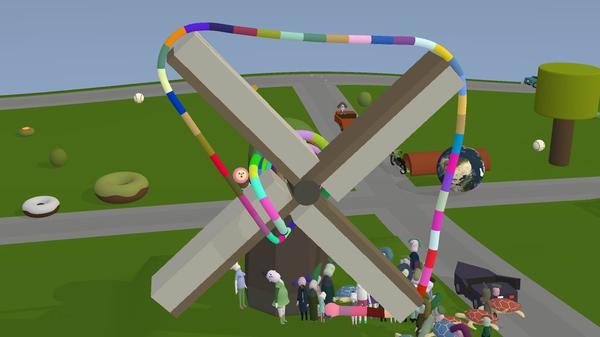
It's difficult to describe in words what Noby Noby Boy is. It's something of a procedurally-generated sandbox game in which there are no goals or pressure to accomplish anything specific. Well, there are some lofty and far-away goals, but it's impossible to accomplish them alone, and they take a great deal of time. More on this later.

Upon hovering over the game's XMB icon, players are greeted with a seemingly hand-painted picture of a group of children climbing, sitting, playing, and generally just amusing themselves on, around, or about a steaming bowl of soup. Yes, a bowl of soup. While this image may seem unrepresentative of gameplay (it is), it's still representative of the playful nature of the game as a whole.

Like the portrait of the steaming playground of a bowl of soup, Noby Noby Boy is an eclectic amalgam of everything fun, carefree, and innocent. Noby Noby Boy makes you feel like a kid again.

Remember the simple joy of visiting an undiscovered play park for the first time, as a child? When you would scurry into a play structure for the first time, you would only want to explore, discover, and see what sorts of unique geometrical shapes the designers had put into the towering playground to amuse you.

The same feelings apply for the suspended aerial-island-plains of Noby Noby Boy. These islands in the sky are procedurally generated, which means you'll never visit the same island twice. Being simply dropped into a strange, colourfully diverse world that begins with just a hint of cohesiveness, your character - a sort of caterpillar-kid known simply as BOY - is free to walk around, explore, offer free rides to pedestrians, and more typically, cause havoc and break the gentle balance of the island's inhabitants.

This is done through an eccentric but intuitive control scheme, one that uses both analogue sticks to control both the front end of BOY's head, as well as his "tail". There are plenty of control quirks to learn, and the controls are as unique and silly as the game's creator, Keita Takahashi, the man behind the Katamari games.    Just as the Katamari games' strange and wonderful controls make the game very different and difficult to explain, so do Noby Noby Boy's.


Since both extremes of BOY's body are controlled by separate analogue sticks, it's possible to stretch him out into a longer form. When this is done, BOY's body changes to a randomly-chosen colour, and the longer length of his body usually means that he will be harder to manage and cause more havoc to the environments around him. "Havoc" is probably too strong a word, though. Yes, BOY knocks people out of their vehicles, eats them, and then excretes them out of his tail section. But despite all this, the game is never crude, violent, or abrasive in any way.

The only effect knocking around an island's denizens has is that the people will run away. The only acknowledgement of having eaten something is a slight bulge in BOY's body, and the way enemies are expelled from BOY's backside is neither crude nor off-putting. BOY's presence isn't even intended to be portrayed as a negative one, since inhabitants will often hitch an impromptu ride on Boy's back, and sometimes even hop onto the back of another rider. It's all completely unplanned, unscripted, and incomprehensible. It's also wonderful.

Equally wonderful is the unparalleled sense of progression this game offers. For all the lengths that BOY stretches, he adds a number to the global stretched length, which is reported by all players. When BOY visits the Sun, he can "donate" his length to a another character called GIRL, whose goal is to stretch out into the universe. Or something. If this all sounds completely crazy, it is. But all this really means that players from around the world contribute to GIRL's length, offering access to new planets with completely different looks, physics, and manifestations. At this point in time, GIRL has reached Uranus, and has yet to reach Neptune and Pluto. GIRL's length is also helped by users of the equally strange (but different) iOS version of the game, priced at 2.99$. Three years after the game's release, and with the added help of iOS users, players still haven't unveiled all the content that is on offer.


Despite all the praise, Noby Noby Boy's controls certainly take some getting used to, and the game's sense of random childhood whimsy and lack of objectives won't appeal to everyone. The game does have local multiplayer - added in an update - but the camera's almost totally manual SixAxis controls make it frustrating to play with any but the masters of the game's bizarre camera-control system.

These minor complaints aside, Noby Noby Boy's ridiculous visuals, relaxing atmosphere, and wholly unique gameplay make this one of the most singular and bizarre titles on the Playstation Network. To top that all off, it's only 5$.